AI Search Visibility Tracker
See when AI recommends you - and when it names a competitor instead.
Your competitors know what AI says about them. You don't. We ask ChatGPT, Claude, Gemini, DeepSeek, Grok and Perplexity the buying questions in your category, and show you exactly where you're mentioned, where a competitor got named instead, and what AI said about you - rolled into one AI Visibility Score, with a ranked list of what to fix.
From /mo · Weekly scans across all six AI engines
✓ Verified ChatGPT result, from our free audit: FileSeal went from 0 AI citations to #1 in ChatGPT, ahead of DocuSign → · See the conversation →



How does AI citation tracking work?
AI citation tracking monitors whether AI search engines (ChatGPT, Claude, Gemini, DeepSeek, Grok and Perplexity) recommend or cite your business when users ask category-relevant questions. SearchScore Tracker runs structured queries and tells you which engines named you, which ranked you, and which named competitors instead. Read the SAVI Report for the broader benchmark.
When a customer asks ChatGPT "who's the best at X?", they don't see ten links. They see three names. You're either one of them, or you're invisible. Traditional SEO tools don't track this. Most of your competitors aren't tracking it either. That changes for whoever notices first.
One question can produce six different winners.
You can be named first by one assistant, buried by another and missing from a third, all on the same question and the same day. A single AI answer tells you almost nothing. Six, tracked weekly, tell you where you actually stand.
Illustrative example. One buying question, put to all six engines: "Who's the best emergency plumber in Bristol?" These are made-up outcomes to show the shape of the report, not measured results.
Named you first.
The answer opens with your business and links your site. The strongest result available on one question.
Named you fourth.
You appear, below three competitors. Present, but not the recommendation a buyer acts on.
Named a competitor instead.
A rival takes the recommendation and you are not mentioned. Tracker records which rival, on which question.
Named you, citing a directory.
You are named because a third-party page said so, not because the engine read your site. Tracker separates the two.
Named nobody local.
The answer stays generic. Nobody in your category wins it, which makes it a question worth going after.
Named you, unfavourably.
Being mentioned is not the same as being recommended. Tracker classifies the tone rather than counting the mention.
What you'll know that your competitors don't.
Whether AI is recommending you, at all.
We ask ChatGPT, Claude, Gemini, DeepSeek, Grok and Perplexity the buying questions in your category. Every week. You'll see exactly which engines name you, and which ones leave you out.
Who AI names instead of you.
When AI doesn't cite you, it names someone else. We surface exactly which competitors get recommended in your place, how often, and on which of the six engines, so you can see who's taking the answer you should be getting.
Exactly what AI said about you.
Being named isn't enough. We capture the sentence AI used and classify it positive, mixed or negative, so you know whether AI called you "the leading option" or "the cheap alternative that compromises on quality," not just whether your name came up.
One brand-safe number that rolls it all up.
All of it rolls into a single 0 to 100 score. It only counts decision-stage questions - the ones buyers ask right before choosing a provider - and it weights each mention by sentiment and position. Questions naming your brand are reported separately, so they do not inflate this score. Retrieval information is shown separately in Citation Trust; it does not change the score. Repeated scans help you assess how consistent the results are. The one number to watch, and to move.
Not just the score, the ranked list of what to fix.
Every scan becomes a list of next moves, ordered by impact. Each shows the score lift it could earn ("+6"), the effort involved, and the evidence behind it. For technical fixes, like an llms.txt file (a simple text file that tells AI tools what your business offers) or Organization schema (a snippet of code that spells out who you are so AI does not guess), we draft the exact text for you to paste in. Specific to your data, never generic SEO advice. How the Action Centre works →
Whether AI cites your live site, or just remembers you.
We show what share of your citations come from AI reading your live pages versus its training memory, how many of the six engines cite you at all, and how often you land in a ranked list versus loose prose. The difference between durable visibility and a lucky mention. How Citation Trust works →
The Tracker shows you what to fix and drafts the change. Want it done for you? The SearchScore Audit and Growth Service implements it end to end - and the Tracker measures the lift.
What you'll see in your dashboard.
One brand-safe AI Visibility Score at the top, built only from the buying questions that move revenue and weighted by sentiment and position. Whether AI cited your live site or its training memory is reported separately, in Citation Trust. Below it: your share of AI voice against competitors, a ranked list of next moves with the score lift each could earn, and a citation heatmap across all six engines. The two images below are screenshots of the real dashboard, taken from an example account, so the layout is exactly what you get and the numbers are illustrative.
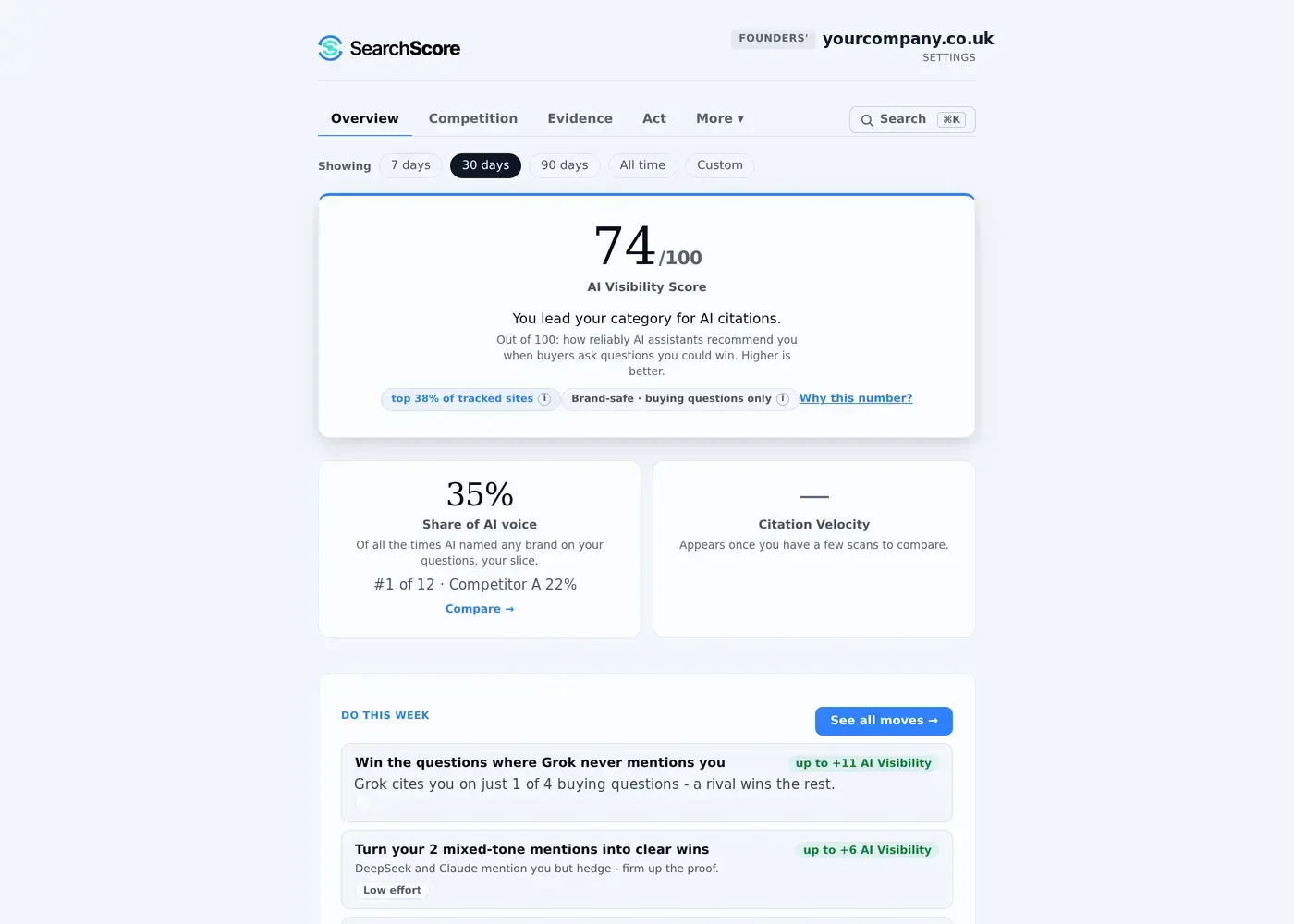
Every question, every engine, one grid.
The citation heatmap shows exactly where you win the AI answer and where a rival takes it, coloured by sentiment and marked with the position you placed in.
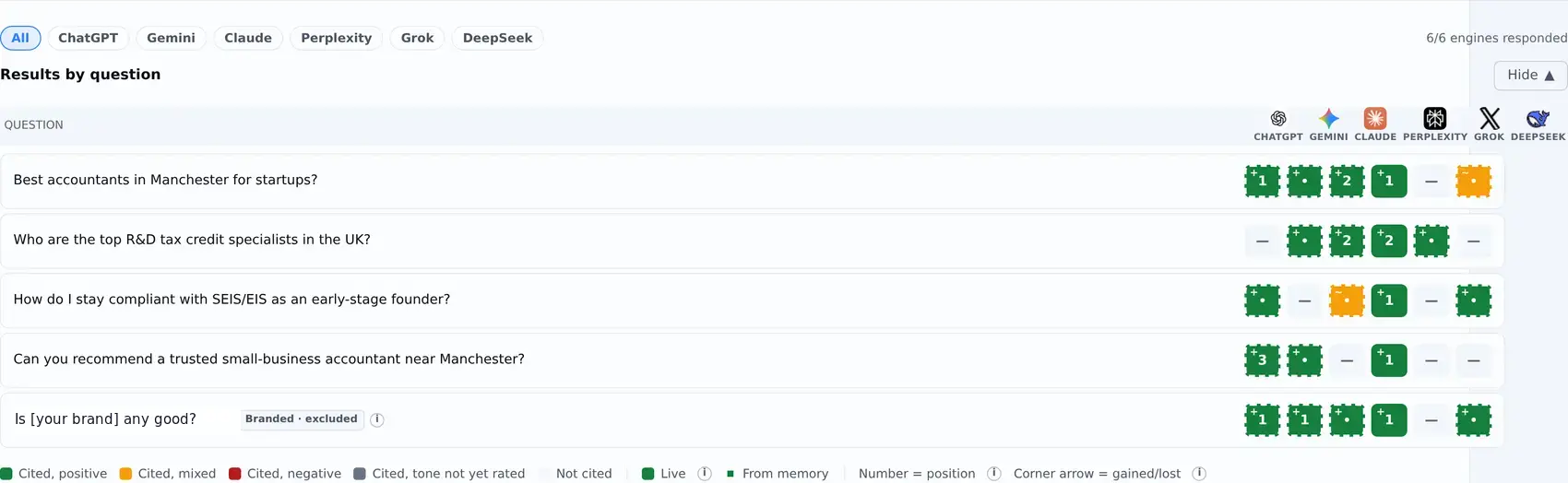
See exactly what each AI said.
Not just whether AI mentioned you. Exactly what it said, where you ranked, and which competitors got named in your place.
This detail view is a recreation, not a screenshot: it is the live product's own markup, filled with an example plumbing business. The layout and fields are real, the data is made up.
What lands in your inbox every week.
Example digest. Exact content depends on your scans:
- Headline: Mention rate up 12% this week. Mentioned in 7 of 10 tracked questions, up from 6 last week.
- New citations: #2 in ChatGPT for "best document signing alternative" (positive). #1 in Perplexity for "secure PDF signing UK" (positive). #3 in Gemini for "DocuSign competitors 2026" (positive).
- Worth a look: Mentioned at #6 in ChatGPT for "cheapest e-sign for freelancers", sentiment negative. AI called you "premium-priced, may not suit budget users."
- Where you got beaten: Missed in 3 questions about "e-signature for small business". All went to competitors. PandaDoc named in all three.
Sample content above. Your actual digest reflects scans against the questions you configured.
Ready to see your own?
Asking six AI engines your buying questions by hand, every week, and logging what each one said, is hours you will not get back. Most consultancies charge £2,000+/mo to do this kind of work for you. SearchScore Tracker starts at /mo.
Four plans. Your first scan starts as soon as you finish setup. Cancel anytime.
Choose your planHow this is different from what you already use.
Ahrefs and Semrush now offer paid AI visibility products as well as SEO. SearchScore Tracker is built around a different workflow: it generates a focused set of buying questions from your business profile and category, quality-checks them before research, runs the approved set across six AI engines, and connects the results to competitors, sources and next actions. For the tool-by-tool detail, see how SearchScore compares.
| What you'll see | SearchScore Tracker | SEO suites + AI products |
|---|---|---|
| AI mentions and citations | ✓ Tracked every week | ✓ Available in paid AI products |
| Buying-question set built for you | ✓ Automatic + quality-gated | Varies by product and setup |
| Who AI names instead of you | ✓ 5 to 20 tracked, by plan | Available in AI products |
| Evidence connected to next actions | ✓ Action Centre + Playbook | Research and reporting |
| AI Search · SEO · CRO in one diagnosis | ✓ All three | AI + SEO; CRO not the focus |
| Plain-English priorities | ✓ Tailored to your evidence | Analysis varies by product |
| Google organic rankings | Not the focus | ✓ Core strength |
| Backlink analysis | Not included | ✓ Core strength |
| Ongoing AI monitoring | ✓ Every week | ✓ Available in paid AI products |
SearchScore is not trying to replace Ahrefs or Semrush for deep keyword and backlink research. The difference is the workflow from buying question to evidence to action.
Your site is only part of the answer.
AI looks across the web before it recommends a business. Directories, review sites, publishers and community threads can all sit behind an answer. So we split the work into three jobs, and you do not need all three at once.
Free SearchScore Audit.
Whether your own website gives AI and search engines the basics they need to understand and trust it. No email, no card. Check my site →
AI Visibility Playbook.
The third-party websites that keep appearing around AI answers in your market, where competitors already show up, and which of them may be worth going after first. A one-off researched snapshot rather than a subscription. See the Playbook →
SearchScore Tracker.
Keep asking the buying questions every week, so you can see whether AI is recommending you and whether that is changing. This page. See Tracker plans →
In one line: Tracker tells you whether AI is choosing you. The Playbook helps you work out which other websites may deserve your attention. Neither claims that getting listed somewhere will make an AI recommend you.
How it works.
Subscribe and we run your first scan.
Add your domain and choose a plan. Your first scan starts as soon as you finish setup, and your dashboard fills in as the results land.
We write the buying questions in your category.
Real category questions like "Who's the best emergency plumber in Bristol?" or "What's the best DocuSign alternative for small business?" You can edit, replace, or add your own. Plus the competitors you want tracked, from 5 on Starter to 20 on Enterprise.
Every week, we tell you what changed.
A weekly digest in your inbox. Your dashboard refreshes after each weekly scan. When things move materially, an alert email between digests.
The four things buyers check first.
What actually separates the plans.
Every tier scans weekly. The plans differ in how much each scan measures, not how often it runs. Starter asks 10 questions twice each. Pro asks 25 questions twice each. Scale asks 50 questions twice each. Enterprise asks 100 questions three times each. Asking the same question more than once is what lets the higher tiers tell a real move apart from AI noise, because the same question put to the same engine twice does not always come back the same way.
Why Search Console does not already do this.
Google Search Console reports impressions and clicks from Google's organic search. It does not track whether ChatGPT, Claude, Gemini, DeepSeek, Grok or Perplexity mention your business in the answers they generate. That is the gap this fills, by putting structured questions to the engines themselves. The two work together: on Scale and Enterprise you can connect your Search Console, and we seed the questions we ask the AI engines from what buyers actually searched for.
Citations under a trading name still count.
Register up to 4 alternate names, whether those are old brands, trading names, acronyms or a rebrand. The Tracker matches all of them against AI responses, so a citation under any of your names counts towards your score rather than being missed.
You can force a rescan after a change.
Deployed an llms.txt file, added schema, rewrote a page? You do not have to wait for the next weekly scan to find out whether it worked. Trigger a fresh scan from your dashboard and watch the scores update.
Questions buyers ask before subscribing.
Short, specific answers. If your question isn't here, the methodology page goes deeper.
What is AI citation tracking?
Which AI engines does the Tracker check?
Does the Tracker tell you if AI is talking positively or negatively about your brand?
Can the Tracker show what position you rank at when AI lists options?
What is the AI Visibility Score?
Does the Tracker tell me what to fix, or just track?
How is this different from Google Search Console?
How often do scans run?
Can the Tracker catch citations under trading names or acronyms?
Does the Tracker track SEO and CRO too, or just AI citations?
Can I force a rescan to see the impact of changes I made?
Are the insights AI-generated or just templated?
Choose your plan.
Your first scan starts as soon as you finish setup.
Measurement grade: Below IAB directional (our label)
For solo operators and small teams tracking the basics.
- 10 questions, each asked twice
- 6 AI engines (ChatGPT, Claude, Gemini, DeepSeek, Grok, Perplexity)
- Weekly scans
- Up to 5 competitors
- Digest + alert emails
Measurement grade: Below IAB directional (our label)
For teams investigating competitors and the sources behind their answers.
- 25 questions, asked twice each
- 6 AI engines (ChatGPT, Claude, Gemini, DeepSeek, Grok, Perplexity)
- Weekly scans
- Up to 10 competitors
- Digest + alert emails
- Source Explorer: inspect websites cited in your market
Two and a half times Starter's questions, so you see which rivals win which parts of your market.
Measurement grade: IAB directional
For agencies and teams needing broader coverage and branded client reports.
- 50 questions, asked twice each
- 6 AI engines (ChatGPT, Claude, Gemini, DeepSeek, Grok, Perplexity)
- Weekly scans
- Up to 15 competitors
- Connect your Search Console and we seed your questions from what buyers actually searched for
- Digest + alert emails
- Live telephone support
- Source Explorer: inspect websites cited in your market
- White-label client reports with your branding
Double the question coverage, which is what narrows the range on your score.
Measurement grade: IAB decision-grade
For teams who have to defend the number to someone else.
- 100 questions, each asked three times
- 6 AI engines
- Weekly scans
- Up to 20 competitors
- Connect your Search Console and we seed your questions from what buyers actually searched for
- Watchlist and Rival Intelligence included
- A named point of contact, live telephone support, an onboarding call, and a reply within one working day
- Source Explorer: inspect websites cited in your market
- White-label client reports with your branding
Included in every paid plan: weekly scans across six AI engines, answer evidence, competitor tracking and email updates. More questions widen coverage; repeated answers reveal variation. Neither guarantees a recommendation.
The framework grades a measurement programme at its weakest criterion. Every paid plan asks each question at least twice, because an answer asked once is a sample of one, which cannot show whether a reading is typical or how far it moves between runs. So what decides the grade now is how many questions a plan tracks: the framework treats fewer than 50 as exploratory. Tier as defined by the IAB measurement quality standards. IAB defines two tiers, directional and decision-grade; "exploratory" is our label for a programme that does not yet reach the lower one. That is what "Below IAB directional" means on the Starter and Pro cards. See how we grade our own measurement.
Upgrade between tiers anytime and it takes effect immediately. To move down a tier, cancel and resubscribe on the tier you want: you keep the tier you paid for until the end of the billing period.
Your details.
Why AI citation tracking matters in 2026.
The shift is already happening. In 2024, most buyers researched B2B purchases by Googling, comparing five tabs, and reading reviews. By the end of 2025, a growing share started asking ChatGPT, Claude, Gemini, Perplexity, Grok or DeepSeek instead, and acted on the names those engines surfaced first. The shortlist isn't ten blue links any more. It's three names in a generated paragraph. You're either named or you're invisible.
Established SEO suites now have paid AI visibility products too. That can be useful if you want AI research inside the same stack. SearchScore is designed around the point where research becomes a decision: it builds the buying-question set for you, rejects weak or off-scope questions before the scan, runs the approved set across six AI engines, and connects what comes back to competitors, sources and the work that should happen next.
What an AI engine says about your business now shapes the decisions of buyers who never visit your website at all. A negative sentiment citation in ChatGPT, something like "X is reliable but premium-priced and may not suit budget users", quietly disqualifies you from every budget-conscious buyer asking that engine for recommendations. You'll never see those buyers in your analytics. They never clicked.
SearchScore starts by generating the buying questions in your category from your business profile, informed by category search demand where available. Weak, duplicate or off-scope questions are rejected before research begins. The approved set is then scanned across ChatGPT, Claude, Gemini, DeepSeek, Grok and Perplexity, with competitor monitoring, source evidence and plain-English priorities tied back to the same questions. None of that replaces a deep SEO suite. It turns AI visibility into a repeatable workflow your team can act on.
The businesses paying attention to AI citations now will own the answers AI generates for years to come. The ones who wait will spend the next three years trying to claw back ground they didn't notice was lost. Start tracking before your competitors do.