Get found by AI. Ranked by Google. Chosen by buyers.
Free AI search visibility checker: see your AI, SEO and conversion scores
Get your business into AI answers. Free audit of your website's readiness for AI search, SEO and conversion, with what to fix first.
- Free scores, no email · Full fix list unlocks with one email
- #1 Amazon Bestseller in Search Engines and Web Marketing
SearchScore is an AI search visibility platform. Start with the free audit: 300+ AI search, SEO and conversion signals. The Playbook finds the websites AI draws on and where to get you listed or mentioned; the Tracker measures weekly how often AI engines name you.
Or try the free AI recommendation check.
Free AI search visibility checker · SEO audit · conversion rate audit. All three in one report.
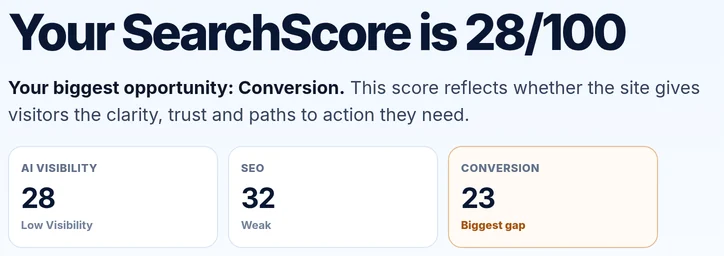
A real results page for example.com, scored by the free audit: AI visibility, SEO and conversion. Captured 19 November 2026.
Your customers are asking AI who to use. It isn't saying you.
The free audit that scores your site out of 100 for AI search, rankings and conversion, the ranked list of what to fix first, and the Tracker that re-asks every week and tells you when a rival takes your place.
An example of an AI assistant answering a customer's buying question. It recommends three other businesses and never mentions yours. SearchScore then shows your AI Search score and the reason you were left out.

Free scores, no email
Get my free scores Free · no signup · no card
Three questions. Two are free.
Can AI read my website?
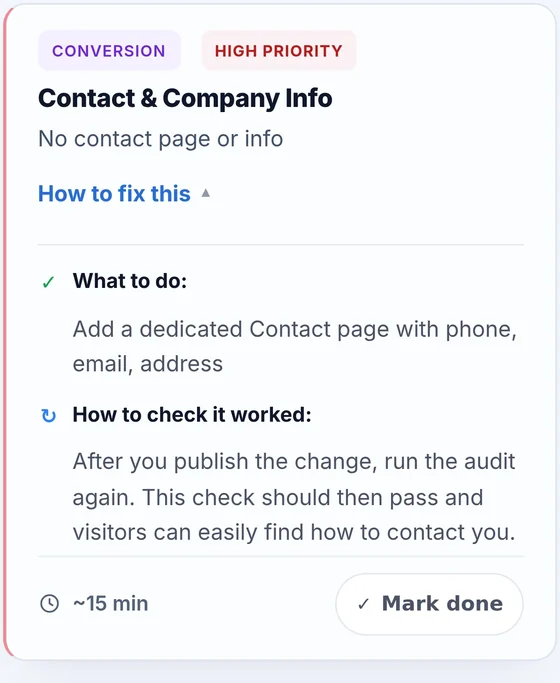
Free website audit · Most audits finish in under 60 seconds · Free scores, no email
Three free audits. 300+ signals. See where you stand.
Does AI name me today?
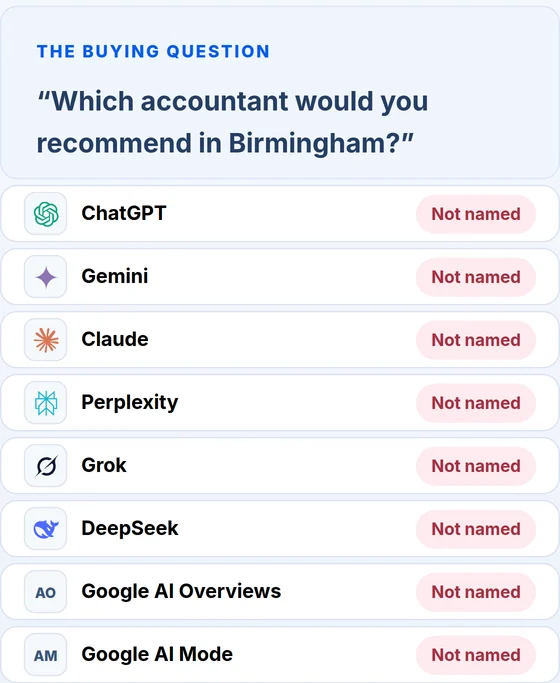
Free AI-Check · one real buyer question
Ask one real buyer question. See which AI engines name you, and who they name instead.
So how do I get named?
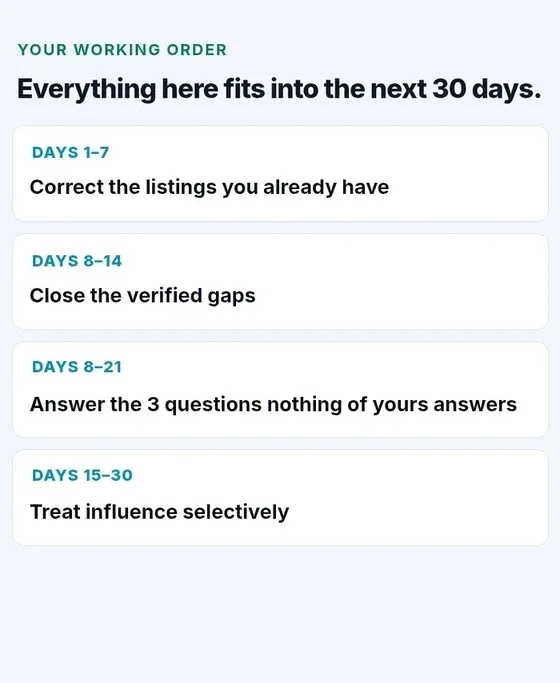
AI Visibility Playbook · One-off · £495
The Playbook finds the websites AI draws on and where to get you listed or mentioned.
The audit shows where you stand. The Tracker shows what changes.
-
Website audit Free · with the Fix-List
Whether your own website gives AI and search engines the basics they need to understand and trust it.
About the audit -
AI-Check Free · one question
Ask one real customer question across six leading AI assistants plus Google AI Overviews and Google AI Mode. See whether they recommend you, or who they recommend instead.
Try the AI-Check -
AI Visibility Playbook One-off · £495
We test the buyer questions that matter, find the businesses AI recommends, trace the websites and sources behind those answers, then turn the evidence into a clear plan for your business.
About the Playbook -
Tracker From £49/mo
Keep asking the buying questions every week, so you can see whether AI names you, and how it describes you, and whether that is changing.
About the Tracker
Also: the Fix-List, the MCP connector for your AI assistant, and products for agencies and for HighLevel. All prices.
These businesses found out what was quietly costing them sales.
Honestly I didn't know this was a thing until we ran the audit. Someone rang us about a corporate event and when I asked how they found us, they said they'd asked ChatGPT. That had literally never happened before.
I work in AI so I assumed we'd score well. We didn't. The audit flagged that our robots.txt was blocking AI crawlers, plus a handful of immediate fixes to boost our authority. The blocker took minutes to sort. Sobering and useful in equal measure.
Ran it across eight client sites in one sitting. Every single one had AI visibility gaps I'd have missed, and I do this for a living.
FileSeal went from 0 AI citations to #1 in ChatGPT, ahead of DocuSign.
In under 45 days, FileSeal became the top recommendation for UK secure-document services, above a competitor 100x their size. They ran the same free audit you can run above, then implemented the fix list themselves.
- 1FileSealBest for secure document collection + delivery
- 2DocuSignBest for enterprise-grade agreements
- 3SignableBest value UK-based e-sign provider
ChatGPT, asked cold. No mention of FileSeal in the prompt. Data as shown.
Before
When we first measured him, five of the six assistants weren't naming him at all.
After
He is named in 100 of the 120 assistant answers.
Most "AI visibility tools" only check half the equation. We don't.
| Capability | SearchScore | Other tools |
|---|---|---|
| Know what's broken without signing up | Full diagnosis free | Score gated, paid trial |
| One audit instead of three agencies | AI + SEO + Conversion in one | Single-axis only |
| See whether AI names you, and how it describes you | 10 questions on Starter, up to 100 on Enterprise, across 8 AI engines: ChatGPT, Claude, Gemini, Perplexity, Grok and DeepSeek, plus Google AI Overviews and Google AI Mode | Brand mentions, maybe |
| Know how much each fix will lift your score | Score-lift projections per fix | Generic checklist |
| Bring in experts when you need them | Consultancy on tap | Tool only, DIY |
We don't guess. We publish.
sites analysed score AI-Ready (GEO 80+), 0.022%, about 1 in 4,600.
Q3 2026 SAVI (Vol. 3) · figures as of 27 July 2026
weighted mean GEO score of the fixed SAVI index panel, 102,873 domains.
Q3 2026 SAVI index panel, wave 1 · 1 August 2026
First we get you found. Then we get you chosen.
Most consultancies sell SEO, CRO or AI visibility as separate things. They aren't separate. We sequence them: foundations first, authority second. And measure both with the same scoring framework.
Self-service
- Website audit and AI-CheckFree scores, no email · Full fix list unlocks with one emailFree
- AI Visibility PlaybookA one-off researched snapshot rather than a subscription.£495 one-off
- TrackerStarter £49/mo · Pro £99/mo · Scale £199/mo · Enterprise £499/mo. Weekly scans across 8 AI engines: ChatGPT, Claude, Gemini, Perplexity, Grok and DeepSeek, plus Google AI Overviews and Google AI Mode.From £49/mo
Done for you
- Visibility Foundations15 working days, final quote confirmed after a discovery callFrom £950
- Visibility Blueprint20 working daysFrom £1,500
- Growth Service3-month minimumFrom £750/mo
What is AI search visibility? And why it sits alongside SEO and conversion.
What is AI search visibility?
AI search visibility is how easily AI-powered search engines – including ChatGPT, Perplexity, Claude, Google AI Overviews and Google AI Mode – find, understand, and recommend a website when users ask the questions that lead to a purchase decision.
SearchScore is an AI search visibility platform that scores how ready a business's website is for AI engines (ChatGPT, Claude, Gemini, Perplexity, Grok, DeepSeek) to find, read and trust, and tracks how often they name it. Covers AI Search (GEO), SEO and conversion. We also do the work for you as a consultancy. The free audit is an AI search visibility checker covering 300+ signals across three disciplines: AI search visibility (GEO), Search Engine Optimisation (SEO), and Conversion Rate Optimisation (CRO). The Tracker monitors your AI search visibility over time across 8 AI engines: ChatGPT, Claude, Gemini, Perplexity, Grok and DeepSeek, plus Google AI Overviews and Google AI Mode.
Methodology authored by Ronnie Huss, founder of SearchScore. The AI search visibility score metric is registered on Wikidata as Q138644643, with the underlying concept "AI search visibility" at Q138646003. Full methodology documentation.
How good those numbers are is published too. Our measurement standards page grades SearchScore against the IAB framework Measuring Visibility in the AI Era, criterion by criterion and plan by plan, and names the criteria each plan falls short on.
Questions about AI search visibility, and working with us.
How do I improve my AI search visibility?
SearchScore groups practical improvements into six site-side areas, but no single item guarantees a citation: (1) allow AI search crawlers (OAI-SearchBot, Claude-SearchBot, PerplexityBot); training crawlers like GPTBot are a separate choice; (2) treat llms.txt as an emerging convention rather than a proven ranking or citation signal; (3) add accurate schema markup that matches the visible page, such as Organisation, Article and Author/Person; (4) structure content with definitional sentences AI engines can quote directly (100-200 words per paragraph, clear topic sentences); (5) build third-party citations and brand mentions across reputable sources; (6) add named, credentialed authors to content. SearchScore's full audit checks 300+ signals across AI visibility, search and conversion.
Which AI engines should I optimise for?
SearchScore Tracker currently monitors 8 AI engines: ChatGPT (OpenAI), Claude (Anthropic), Gemini (Google), Perplexity, Grok (xAI) and DeepSeek, plus Google AI Overviews and Google AI Mode. Each crawls differently, weights signals differently, and ranks sources differently. The good news: the underlying technical foundations – schema, crawler access, content structure, author authority – are shared across all six. Improvement on one engine does not guarantee improvement on another. SearchScore Tracker monitors all six weekly.
What is Generative Engine Optimisation (GEO)?
Generative Engine Optimisation (GEO) is the practice of structuring a website so AI systems like ChatGPT, Perplexity, Claude, Google AI Overviews and Google AI Mode can find, read and use it when answering user queries. Where SEO optimises for ranking on search results pages, GEO optimises for being recommended inside AI-generated answers. GEO covers technical signals (llms.txt, schema, AI crawler access), content signals (quotable passage structure, EEAT, author authority), and behavioural signals (brand mentions, third-party citations).
How is GEO different from SEO?
SEO focuses on visibility in conventional search results. GEO focuses on making a brand and its content accessible, understandable and attributable in AI-generated answers. The disciplines share foundations such as crawlability, structured data and content quality. GEO also examines AI crawler policies, extractable answer structure and entity clarity; SearchScore monitors llms.txt as an emerging convention, not as a proven ranking signal. Actual AI mentions and citations must be measured separately.
What's the difference between the SearchScore audit and the Tracker?
The free audit is a one-off scan that gives you AI Search, SEO, and CRO scores plus a prioritised fix list. Free, run anytime at searchscore.io. The Tracker is ongoing monitoring how often AI names you across ChatGPT, Claude, Gemini, Perplexity, Grok, and DeepSeek, with weekly scans. Subscription, from £49/mo. Most subscribers run the free audit first to understand their baseline, then move to the Tracker to monitor changes over time.
How fast will I see results?
Most SearchScore clients see measurable score movement within 7-14 days of implementing prioritised fixes. Being named in AI answers (ChatGPT or Perplexity) typically follows in 30-90 days, depending on baseline authority and the competitive landscape in your category. Both score movement and how often AI names you are tracked weekly through the Tracker (from £49/mo), on its own or as part of the Growth Service (from £750/month).
Why is my website not showing in ChatGPT?
There is no single site-side reason a website is absent from a ChatGPT answer. Possible factors include crawler policy, indexability or rendering, weak entity information, content that does not answer the query clearly, limited off-site corroboration, and model or query variation. The free SearchScore audit measures site-side readiness; Tracker measures whether ChatGPT actually names or cites the business.
How do AI tools choose which websites to cite?
SearchScore does not claim a universal citation formula. In observed AI responses, citation can depend on query relevance, retrievability, source and brand authority, engine-specific behaviour and other factors. Site-side signals can improve accessibility and extractability, but actual citation has to be measured in the engine response.
What is AI citability and how do I improve it?
AI citability is SearchScore's measure of how readily page content can be extracted and attributed as a clean answer. Useful site-side improvements can include clear self-contained passages, appropriate structured data, accessible rendering, explicit authorship and accurate crawler policies. SearchScore also detects llms.txt as an emerging convention, but does not treat it as a proven citation signal. Actual citation is measured separately in Tracker.
What is llms.txt and do I need one?
llms.txt is a plain-text file placed at the root of a website (yourdomain.com/llms.txt) that declares the site's purpose, key pages, and content guidance specifically for AI systems. It is designed to work like robots.txt, but aimed at AI systems rather than search crawlers. SearchScore checks two things: that you have one, and that it is well formed, meaning a real heading and proper Markdown links rather than a list of bare URLs, which is the standard the Lighthouse validator applies. Treat it as an emerging convention rather than a proven ranking or citation signal. No AI search engine has confirmed reading one.
How is SearchScore different from Ahrefs, Semrush or other AI tools?
Most tools cover one axis: usually traditional SEO or brand mentions. We cover AI Search, SEO and Conversion in one audit, AND benchmark you against 1,000,000+ sites so you know where you actually rank. We also offer done-for-you implementation, which most tools can't. SearchScore's SEO score covers the same core signal categories as established SEO platforms – schema markup, technical fundamentals, content structure, topical authority – but condenses them into a single 0-100 number that's directly comparable across sites and benchmarked against 1,000,000+ others in our dataset. It doesn't replace Ahrefs or Semrush for keyword research and rank tracking. Most clients use both: SearchScore for the overall verdict, Ahrefs or Semrush for the deep dives.
What does CRO actually check – what's in the score?
Conversion Rate Optimisation (CRO) addresses the structural reasons visitors leave without buying. SearchScore checks 30+ conversion signals across 7 categories: above-the-fold messaging clarity, trust signal placement (reviews, badges, social proof), call-to-action visibility and friction, form length and field count, page speed and Core Web Vitals, mobile usability, and checkout or lead-capture flow steps. The CRO score is the most immediately actionable of the three – most issues can be fixed within days, not months.
Is the SearchScore audit really free? What's the catch?
No catch. Drop your URL and you immediately see all three scores (AI Search, SEO, CRO), the full category breakdown bar charts, and a list of what's actually broken. All free, no email required. The email gate only sits between you and the prioritised fix list (severity × impact ranked, with score-lift projections and implementation guidance). After that, we follow up personally if it looks like we can help. No card, no trial, no auto-charge.
How do I track my AI search visibility over time?
The SearchScore Tracker tracks how often AI names you across ChatGPT, Claude, Gemini, Perplexity, Grok and DeepSeek on an ongoing basis. Set the buying questions in your category, add competitors, and watch your AI search visibility score change week by week. There are four public paid plans and every one of them scans weekly: Starter at £49/mo, Pro at £99/mo, Scale at £199/mo and Enterprise at £499/mo. They differ in how much each scan measures, not in how often it runs. Starter asks 10 questions twice each, Pro asks 25 questions twice each, Scale asks 50 questions twice each, and Enterprise asks 100 questions three times each, so the higher plans measure more of your market and can tell a real move apart from AI noise.
How is the free AI recommendation check different from the website audit?
This check answers "Does AI name my business?" The website audit answers "Is my website technically ready for AI search?" If the check shows that you are missing, the audit can help diagnose technical, content, authority and structured-data issues that may be worth fixing.
Does one check tell me everything?
No. A single check shows what each assistant answered to that question at that time. The AI Visibility Playbook expands the check across a broader set of customer questions and AI experiences, and the Tracker measures visibility over time so you can see whether changes translate into more recommendations and citations.
Is the Playbook a subscription?
No. The AI Visibility Playbook is a one-off researched snapshot rather than a subscription.
How often does the Tracker run?
Every tier scans weekly. The plans differ in how much each scan measures, not how often it runs.
How does SearchScore compare to Profound, Otterly, or Peec?
SearchScore Tracker covers tracking how often AI names you across the same major AI engines (ChatGPT, Claude, Gemini, Perplexity, Grok, DeepSeek) as those tools but with broader scope – it also tracks AI Search, SEO, and CRO scores together over time, with plain-English insights and competitor mention monitoring. SearchScore is built for businesses tracking their AI visibility weekly, with a free audit entry point at searchscore.io and Tracker subscriptions from £49/mo. Profound focuses on enterprise AI search analytics. Otterly and Peec are earlier-stage tools in the same category.
What is the difference between Foundations and the Growth Service?
Visibility Foundations (from £950 one-off, 15 working days) makes your site technically ready: schema deployed, llms.txt configured, structured content in place, a baseline of how often AI names you. It has a clear finish line. The Monthly Growth Service (from £750/month, 3-month minimum) is ongoing work: authority building through earned mentions, shaping the narrative AI repeats, tracking weekly how often AI names you, defending your score against competitors. Foundations gets you found; the Growth Service gets you chosen.
Research, data and commentary on AI search.
Featured guides
- What is GEO (generative engine optimisation)?
- How to rank in AI search results
- Why your website is invisible to AI
- Best AI visibility tools in 2026
- The GEO glossary
- Track AI traffic in GA4
- How AI search visibility works
- How to show up in ChatGPT answers
- Technical GEO checklist
- The answer-first content method
- What is an AI visibility score?
- All guides
Research
- 19,998 Sites Block GPTBot While Allowing OpenAI Search
- The Ceiling: Nobody Has Cleared It
- Microsoft's AI Shopping Guide, Translated for Service Businesses
- Search Console Now Tracks Your Social Profiles
- Google Query Fan-Out: Why One Keyword Isn't Enough
- Google's OKF: Why We're Not Rushing
- All research
SAVI reports
- SAVI Report
- Nobody Has Cleared The Bar
- How AI Engines Choose Which Brands to Name
- UK Business AI Search Visibility
Benchmarks and proof
Intelligence
- Explore SearchScore Intelligence
- Ask the Engine
- Knowledge OS · 508 knowledge objects
- SearchScore Labs
Find out where you stand. Then decide if you want help.
Or try the free AI recommendation check.